Archive for June, 2020
How and why I joined West Ham
How and why I joined West Ham United – Teddy Sheringham and other former West Ham players give a personal insight how they came to play in Claret and Blue:
https://www.whufc.com/news/articles/2020/june/13-june/how-and-why-i-joined-west-ham-united-teddy-sheringham
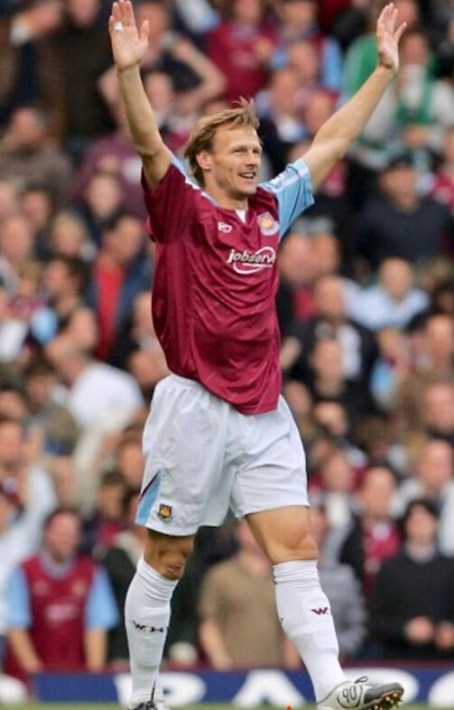
38 year old Sheringham signed a one year deal with West Ham for the season 2004/05. That was the second consecutive season that West Ham, the club he had supported as a boy growing up in east London, played in the Championship. The Hammers had missed out to get back to the Premier League when they lost in the play-off-Final to Crystal Palace in May 2004. Then manager Alan Pardew phoned Teddy Sheringham who had been with PL Club Portsmouth the season before, and it didn’t take much to convince him to join West Ham.
Sheringham scored in his first West Ham game, went on to net 20 goals that season and helped the Hammers to achieve promotion to the PL (winning the play-offs with a win over Preston Northend). He was named Championship player of the year.
In the top flight, Sheringham would go on to reach another FA Cup Final and become both the Premier League’s oldest outfield player (40 years, 272 days) and oldest player to score in a Premier League match (40 years, 268 days), two records that still stand to this day.
“Bubbles” against Lockdown
“I’m delighted the Prime Minister just announced the Government supports bubbles,” radio presenter, political commentator and West Ham blogger Iain Dale tweeted recently.
However Boris Johnson didn’t talk of West Ham’s song “Bubbles”, but of “social bubbles” that will be allowed from next Saturday. That’s going to be one week prior to the day when this tune will be heard again in London Stadium, when West Ham take on Wolves in their first game of the restart of the Premier League, albeit in an empty ground.
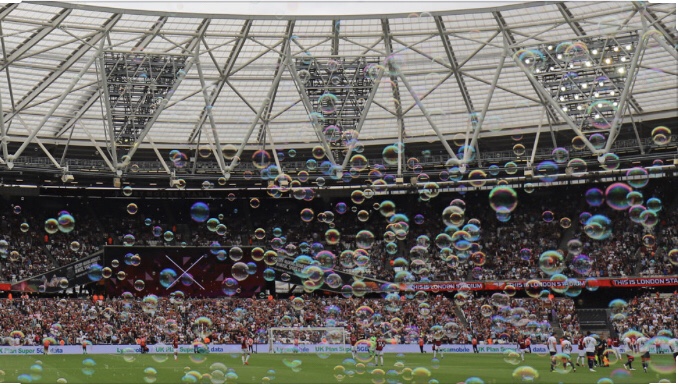
“Too many people are lonely and struggling,” the Prime Minister said and told the people that are in lockdown in the UK since March, that they can go to each other’s houses, stay the night and will not have to maintain two-metre social distancing. From Saturday 13 June, people living alone and single parent households can create a “social bubble” with one other household. This announcement was made by Boris Johnson who is also planning to change other Covid-19 rules. There are plans to scrap the UK’s two-meter-rule, possibly introducing the WHO’s 1 m standard.
The measures introduced since March 23 were some of the most draconian the UK has ever faced and resulted in a huge shift in how people behave. However it took the British government quite a long time until they accepted that the UK had to impose the same kind of measures that had already been in place in other countries.
Similar measures had been imposed in Austria by March 15, more than a week earlier than in the UK. In Austria the measures now have already been eased step by step, beginning from May 1 with the so-called “Lockerungsverordnung” (regulation on relaxing the Covid-19-measures). Now even travelling abroad to neighbouring countries is possible though Austrians will have to wait until June 16 to be able to make holiday in Italy. A stark contrast however to allowing “social bubbles” consisting of two households in the UK.
The initial UK lockdown rules were enacted by new legislation (PDF) that gave the government powers to impose upon people’s freedoms. At the start, lockdown rules said people could only go outside for four reasons (food shopping, exercising alone, medical issues, and providing care) and could not meet with other people. People who were vulnerable were asked to shelter for 12 weeks.
The changes were a stark escalation of the government’s response to the pandemic. On March 16, people had been told to avoid all non-essential contact with others and four days later, on March 20, all bars, pubs, cafes and restaurants were closed. Subsequently all schools and childcare facilities, except for the children of key workers, were closed.
The number of coronavirus deaths in the UK could have been halved if the government had introduced the lockdown a week earlier, according to Prof Neil Ferguson who claimed that an earlier introduction would have saved many lives.
On May 31 the government published new legislation that legally changed the lockdown – this arrived in the form of The Health Protection (Coronavirus, Restrictions) (England) (Amendment) (No. 3) Regulations 2020.
Last Monday meeting outside in groups of up to six people was allowed by the government provided they are socially distant, but gatherings indoors are still prohibited by the law. The “support bubbles” now allow two households to meet indoors and act as if they live in the same household, making it possible to meet grandparents and to combine single parents with another household. Also couples who did not live in the same household now can be reunited after almost three months of social distancing.
The UK’s lockdown rules, explained ▶️wired.co.uk/article/uk-lockdown

Noch eine Woche ohne Premier League
Nur noch eine Woche, bis auch in England, am 17. Juni, der Re-Start des Fußballs beginnt. Das letzte Match wurde am 9. März zwischen Leicester und Aston Villa gespielt. Die Foxes gewannen ihr Heimspiel an diesem Montag mit 4:0. Seither ruht die Liga “due to Coronavirus” und der Tabellenstand blieb unverändert:
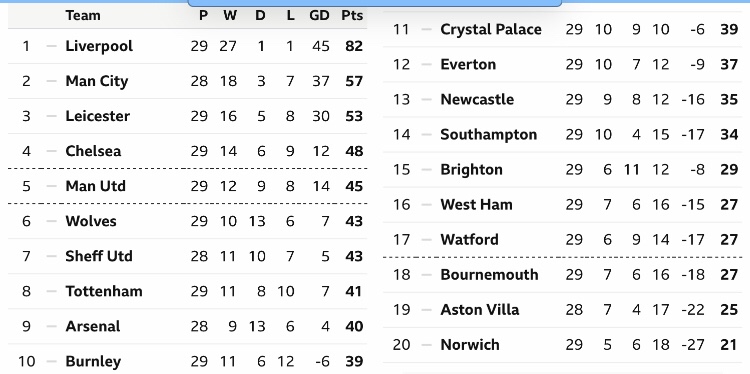
Während der Titelkampf praktisch entschieden ist und Liverpool, das 25 Punkte Vorsprung auf Manchester City hat, nur noch einen Sieg im Stadtderby gegen Everton (am Sonntag, 21. Juni) braucht, um zum ersten Mal seit 1990 als Meister festzustehen, wird es in den verbleibenden neun Runden am Tabellenende noch sehr spannend zugehen.
Voraussichtlich werden es fünf Klubs sein, die im kommenden “relegation dogfight” den Absteiger unter sich ausmachen, denn dem aktuellen Tabellenletzten Norwich (21 Punkte) fehlen doch schon sechs Punkte auf den rettenden 17. Platz, und Southampton als Vierzehnter liegt immerhin fünf Punkte vor dem Fünfzehnten Brighton (29 Punkte).
Von Brighton abwärts liegen die Klubs eng beisammen: West Ham und Watford (27 Punkte) sind nur durch die Tordifferenz vom ersten Abstiegsplatz getrennt, den Bournemouth einnimmt. League Cup-Finalist Aston Villa (25 Punkte) ist Vorletzter, mit einem Spiel weniger liegt man nach Verlustpunkten aber noch vor WHU und Watford. Das Nachtragsspiel, mit dem die Liga am kommenden Mittwoch um 19:00 Uhr (MESZ) startet, bestreitet Villa gegen Sheffield Utd und könnte damit schon Boden gegenüber den anderen “relegation strugglers” gutmachen.
Das sind nun die Spiele der sechs Klubs im Tabellenkeller bis zum Saisonende (die Gegner aus den “top ten” sind im Folgenden in Blockbuchstaben geschrieben; Tabellenplatz und bisherige Punkte sind neben dem Klubnamen angegeben. Zur Einstimmung und Erinnerung an die Form der Klubs vor der Unterbrechung sind auch die Resultate der beiden letzten gespielten Runden “home” und “away” mit dem Ergebnis verzeichnet)
15. Brighton (29)
Home v Palace 0:1; ARSENAL; MAN UTD; LIVERPOOL; MAN CITY; Newcastle
Away v WOLVES 0:0; LEICESTER; Norwich; Southampton; BURNLEY
16. West Ham (27)
Home v Southampton 3:1; WOLVES; CHELSEA; BURNLEY; Watford; Villa
Away v ARSENAL 0:1; SPURS; Newcastle; Norwich, MAN UTD
17. Watford (27)
Home v LIVERPOOL 3:0; LEICESTER; S’hampton; Norwich; Newcastle; MAN CITY
Away v Palace 0:1; BURNLEY; CHELSEA; West Ham; ARSENAL
18. Bournemouth (27)
Home v CHELSEA 2:2; Palace; Newcastle; SPURS; LEICESTER; Southampton
Away v LIVERPOOL 1-2; WOLVES; MAN UTD; Everton; MAN CITY
19. Aston Villa (25)
Home v CHELSEA; WOLVES; MAN UTD; Palace; SHEFF UTD; ARSENAL
Away v LEICESTER 0:4; Newcastle; LIVERPOOL; Everton; West Ham
20. Norwich (21)
Home v LEICESTER 1:0; S’hampton; Everton; Brighton; West Ham; BURNLEY
Away v SHEFF UTD 0:1; ARSENAL; Watford; CHELSEA; MAN CITY
Music Is Back!
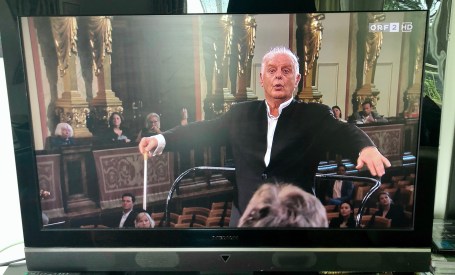 Daniel Barenboim und die Wiener Philharmoniker im Musikverein
Nicht nur der Fußball rollt wieder – auch die ersten klassischen Konzerte gibt es wieder in Wien! Im Musikverein dirigierte Daniel Barenboim Mozart und Beethovens Fünfte.
Endlich.
PL Restart Dates Confirmed
West Ham United confirmed the Club’s first three fixtures on the restart of the 2019/20 Premier League season. After two outstanding games involving League Cup finalists Aston Villa and Manchester City are played on Wednesday 17 June, the first full match round will begin on Friday 19 June. Due to COVID-19, games will take place without supporters present and all 92 remaining matches will be broadcasted live in the UK. BBC Radio 5 Live and talkSPORT will also provide live radio commentaries for all the remaining matches.

No players have tested positive for Coronavirus in the last round of testing in the Premier League. Therefore it seems to be no risk to resume playing games in the Premier League – suspended since 13 March – albeit behind closed doors on 17 June when Aston Villa host Sheffield United at 18:00 BST andManchester City entertain Arsenal at 20:15.
Liverpool are 25 points clear at the top of the table, while Bournemouth, Aston Villa and Norwich City are in the relegation zone.
There are 92 games remaining this season.
West Ham will return to action with the visit of Wolverhampton Wanderers to London Stadium on Saturday 20 June, with kick-off at 5.30pm.
David Moyes’ squad then will make the short trip to Tottenham Hotspur on Tuesday 23 June, with kick-off at 8.15pm.
Thirdly, Chelsea will visit London Stadium on Wednesday 1 July at 8.15pm. The Irons will not have a fixture over the weekend of 27/28 June due to Chelsea’s participation in the Emirates FA Cup quarter-finals.
All three fixtures will be broadcast live in the UK by Sky Sports and across the world by the Premier League’s international broadcast partners.
West Ham United ensured its fans of the huge disappointment that the supporters will not be able to give their passionate backing to the team in person at London Stadium and on their travels, but that they were at the heart of their thinking. Dates and kick-off times for West Ham’s final six fixtures of the 2019/20 Premier League season would be confirmed in due course.
How Shall Society Be Rebuilt After Covid-19?
Demos, a UK educational charity, has started Renew Normal, a national conversation around what should happen after the COVID-19 crisis. A million people will be invited to propose ideas how daily life should change after the pandemic.

The lockdown has changed society brutally from one day to the next. Now the restrictions are going to be eased, and “normal life” will become possible again step by step. But the question is whether we want to do everything again as we did before or if we take this opportunity to shape our lives and societies in order to live in a better world when the Corona crisis is over.
Just as after a recovered illness the person who has been restored to health should ask himself what has to be changed about his lifestyle, also state and society should ask how one wants to shape life after Covid-19. A mere “back to normal”, without thinking twice, would not be the right way – rather we should learn from this crisis and use it as an opportunity to tackle wrong developments and make our lives and our society better than before the pandemic.
The British think tank “Demos” is pursuing this goal and has started a national conversation about the future that people want to come out of the current situation and how they can work together to secure it. They have launched the website “Renew Normal” and established an expert commission. A survey has been started in which a million people are planned to take part. The survey’s results are evaluated by the commission, discussed with the public and, finally, proposals are to be made to the government. The aim is to bring the voices and stories of the citizens to the politicians, and let those voices set the agenda for the future.

I think this is a brilliant idea, which should be adopted within other countries, too! Who could launch such a national dialogue in Austria?
On its website, “Demos” describes its approach as follows:
“To start with, we need as many people as possible to tell us how life has changed and how you feel about it. We want to know what’s important to you, what you’ve struggled with and also any ways your life has improved or been easier. At the same time, we’ll look at all the changes made by government, businesses and other institutions throughout the period – from the furlough scheme to how schools have coped – as well as find out anything we can about what people are doing differently – exercising more, for example. We’ll publish what we find out in a report by the end of the summer.
“Next we’ll work with our expert commissioners on the issues you’ve told us are most important to you. Using lots of different methods, we’ll take what we learned from the first part of the project and delve deeper into finding out how different people have been affected by the changes, and suggest different solutions for people to discuss. We’re particularly looking for things you’ve said you’d like to go back to the way they were, and things you’d like to see change permanently, and how difficult making that happen will be. If you’d like to stay involved in the project, we’d love to ask your opinion again throughout this stage, so we can make sure as many people as possible agree with what we find.
“Finally, again working with our commissioners, we’ll take what we’ve learned to the government in the form of policies they can implement. This way, people from all walks of life will have been involved in deciding how we rebuild our society, and we can make sure it’s one that’s better for everyone.”
Demos is an educational charity. Find out more about it at demos.co.uk.

 EXTRA TIME
Recent Comments