Nascent Life vs. Personal Liberty?
June 25, 2022 at 7:24 am Leave a comment
The US Supreme Court has overturned 50 years of abortion law in a new ruling. According to its decision in the case “Dobbs versus Jackson Women’s Health Organisation“, which was published on Friday – just one day after an other controversial ruling on bearing firearms was issued – the Supreme Court ruled that US states can restrict or ban abortions, as the choice to terminate pregnancy is not solely a “personal decision” which would be protected by Section 1 of the 14th Amendment to the U.S. Constitution. The Fourteenth Amendment states that it is unconstitutional to deprive any person of “life” and of personal “liberty (…) without due process of law”.

“No State shall make or enforce any law which shall abridge the privileges or immunities of citizens of the United States; nor shall any State deprive any person of life, liberty, or property, without due process of law; nor deny to any person within its jurisdiction the equal protection of the laws.” (U.S. Constitution, Fourteenth Amendment, Section 1: Rights Guaranteed)
The new case involves a Mississippi state law that prohibits abortions after the 15th week of pregnancy except in medical emergencies. A clinic that performs abortions filed a lawsuit against the law – and lost.
The Supreme Court used this decision to reopen two other earlier cases: “Roe versus Wade” and “Casey versus Planned Parenthood”. In 1973 and 1992, the court had ruled in two landmark decisions that women in the US generally had the right to terminate their pregnancies as long as the fetus was not yet viable outside the womb. “We hold that Roe and Casey must be overruled,” Justice Samuel Alito writes in his reasoning for the ruling which has found a 6:3 majority within the court. This puts abortion law in the USA back at the same level as it was 50 years ago.
In the German newspaper „Die Zeit“ it is explained that this ruling does not mean that abortions are now banned across the United States. “The Alito decision does not make abortions illegal,” says Kirk Junker, professor at the University of Cologne and an expert on US law. But it does give states the power to make abortions illegal through legislation. Thus, the Supreme Court’s reasoning says: “It is time (…) to return the question of abortion to the representatives elected by the people.” The court thus sees the constitutional right to decide on the continuation of a pregnancy with the state as legislator – and not with the person concerned himself.
British newspaper “The Times” explains why abortion has remained a source of political controversy in America for 50 years, whereas this is not the case in Britain or in Austria. The reason lies in the way in which the law was established. Whereas in Europe, it usually was parliament that enshrined a woman’s right to choose, in America it was the Supreme Court that led the way. In Roe v Wade, it ruled that state laws outlawing abortion in all circumstances were unconstitutional, citing the 14th amendment which protects “personal liberty”. Instead, the court set out its own criteria for when a termination would be legal, effectively creating federal law. That prompted accusations at the time, and which have reverberated ever since, of judicial overreach, ensuring abortion has remained an area of political controversy.
Now in the new decision, the nine Supreme Court justices voted by six to three to quash the 1973 precedent that has enshrined the legal right to abortion in the US for five decades, handing power back to individual states. More than half the 50 US states are set to enact near-total bans on abortion.
Roe v Wade had faced several legal challenges since 1973, most notably in the 1992 case Planned Parenthood v Casey, when the Supreme Court reaffirmed the precedent in a contentious 5-4 vote. Yesterday’s ruling marks the culmination of a decades-long campaign by “pro-life” groups.
The formal challenge to Roe v Wade itself was brought by Mississippi, which sought to reimpose a state law banning abortions after 15 weeks that had been struck down by lower courts. Appealing to the Supreme Court last year, Mississippi argued that the simplest solution would be to overturn the precedent set almost 50 years ago by Roe v Wade altogether.
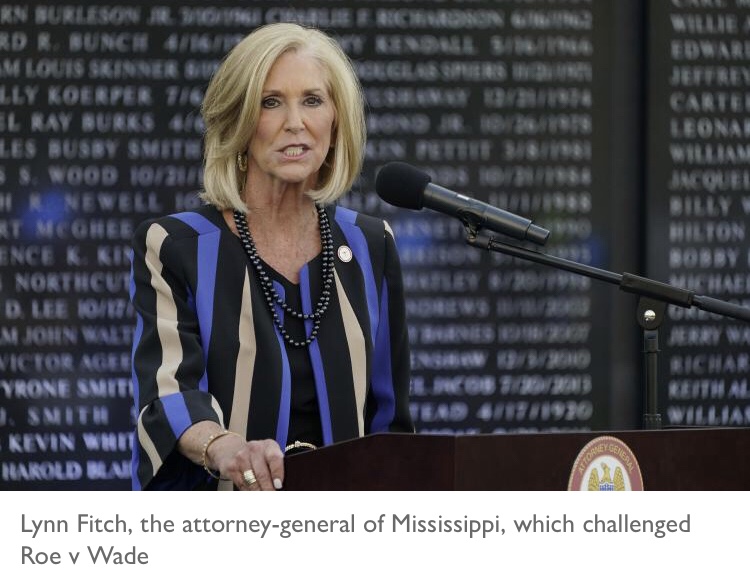
Lynn Fitch, Mississippi’s Republican attorney-general, said that Roe v Wade and the 1992 Casey ruling were “unprincipled decisions that have damaged the democratic process, poisoned our national discourse [and] plagued the law”.
Triumphant conservatives celebrated the ruling, among them the former vice-president Mike Pence, who issued a statement declaring: “Today, life won.” He praised the justices for “having the courage of their convictions”, saying they had “righted a historic wrong”.
“The Times” expects the next battle to centre on patients who leave their state to have a legal termination, and on banning them from receiving abortion pills by post. Legislators in Missouri proposed laws this year that would allow action against anyone helping a patient cross state lines. It was blocked, but similar proposals are expected to follow. They raise the prospect of legal battles between states that will deepen the country’s political divide.
This divide will also be fuelled further by an other controversial ruling of the Supreme Court issued just one day earlier: in the Court’s decision in NYSRPA v. Bruen the judges affirmed that the right to bear arms according to the 2nd Amendment does not stop at a person’s front door, whereas New York’s proper-cause requirement violates the Fourteenth Amendment in that it prevents citizens with “ordinary self-defense needs” from exercising their right to keep and bear arms. This decision has also found a 6:3 majority within the Supreme Court.

U.S. Supreme Court decision of 24 June 2022 ▶️ DOBBS, STATE HEALTH OFFICER OF THE MISSISSIPPI DEPARTMENT OF HEALTH, ET AL. v. JACKSON WOMEN’S HEALTH ORGANIZATION ET AL.
U.S. Supreme Court decision of 23 June 2022 ▶️ NEW YORK STATE RIFLE & PISTOL ASSOCIATION, INC., ET AL. v. BRUEN, SUPERINTENDENT OF NEW YORK STATE POLICE, ET AL.
Entry filed under: Uncategorized.

 EXTRA TIME
Trackback this post | Subscribe to the comments via RSS Feed