Archive for April 1, 2023
“Climate King” in Germany
Though eyebrows were raised when it was announced that King Charles’s first state visit since ascending the throne would be to Europe rather than to a Commonwealth nation, and his visit to France was postponed amid unrest over pension reforms, the monarch’s visit to Germany was a big success. (Quotes from The Telegraph)

The undoubted success of the King’s German visit and the warmth of the welcome he and the Queen have received shows it to have been a good choice for the beginning of his reign. The King’s German antecedents are well-known but his own personal association perhaps less so. He has been to the country 40 times, the first when he was a 13-year-old, and demonstrated his facility with the language by delivering much of his speech at the Bundestag in Berlin in German. It was warmly received by German MPs, who responded to the King’s evident love of their country and whose good humour and cultural references were greatly appreciated.
This visit is all of a piece with Rishi Sunak’s efforts to reset the UK’s relationship with Europe, an ambition that the King shares, judging by his welcome for the EU Commission president Ursula von der Leyen at Windsor recently. Showing the leaders of Europe’s biggest nation that Britain remains a friendly and influential neighbour is part of that strategy. As with the late Queen’s in 1965, this state visit feels like the beginnings of a new era in Anglo-German relations.
“Our countries are working together to promote global health, to help developing countries overcome their challenges and prosper and to advance the urgent and vital journey towards net zero.”

Some German newspapers have dubbed Charles III the “Climate King” and “King Cool”, and asked whether King Charles would vote Green. They declared “A king is supposed to be neutral. When it comes to environmental and climate protection, Charles is not. He can’t vote. But he would vote green if he could.” They also said that the King, who has visited Germany over 40 times, “sees us Germans as natural allies in this ecological revolution.”
Renate Künast, a senior MP for the Green Party which is currently part of the German coalition government, said she once met Charles for tea and cucumber sandwiches at Highgrove when she was a minister and called him “a Green King”.
Though Charles avoided the word “Brexit”, he also referenced to it, saying that despite the UK’s withdrawal from the EU, the bond between the two countries “will remain firm”.
After his visit to Berlin and the speech at the “Bundestag” the King visited Hamburg, Germany’s “most British city”, where hundreds of well-wishers braved the rain to cheer the King and Queen consort. Many were impressed that he had come in a normal Intercity Express train and paid for his own ticket.
The King stood shoulder to shoulder with Germany’s president in a symbol of reconciliation as they laid wreaths in remembrance of the victims of war and the bombing of Hamburg.
In the ruins of a bombed out Hamburg church, destroyed like much of the city by Second World War Allied raids, King Charles and Frank-Walter Steinmeier stood motionless after leaving floral tributes.
The King’s wreath of poppies featured a handwritten card with the poignant message “In everlasting remembrance“ with the same words in German below and the signature “Charles R”. Queen Consort Camilla left her own tribute of a single white rose.
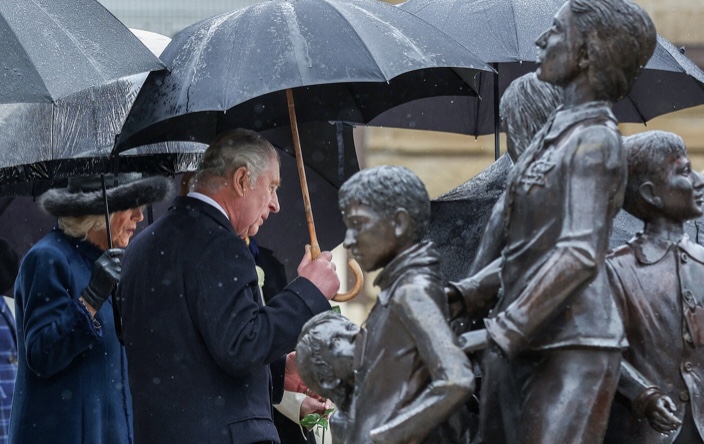
She had earlier laid a white rose on the bronze Final Parting kindertransport sculpture, which was erected in 2015 and depicts two groups of children – those who were evacuated to new lives abroad and the thousands transported by train to concentration camps.
Created by Frank Meisler, it is one of five such installations across Europe, one of which is at Liverpool Street Station in London (below).
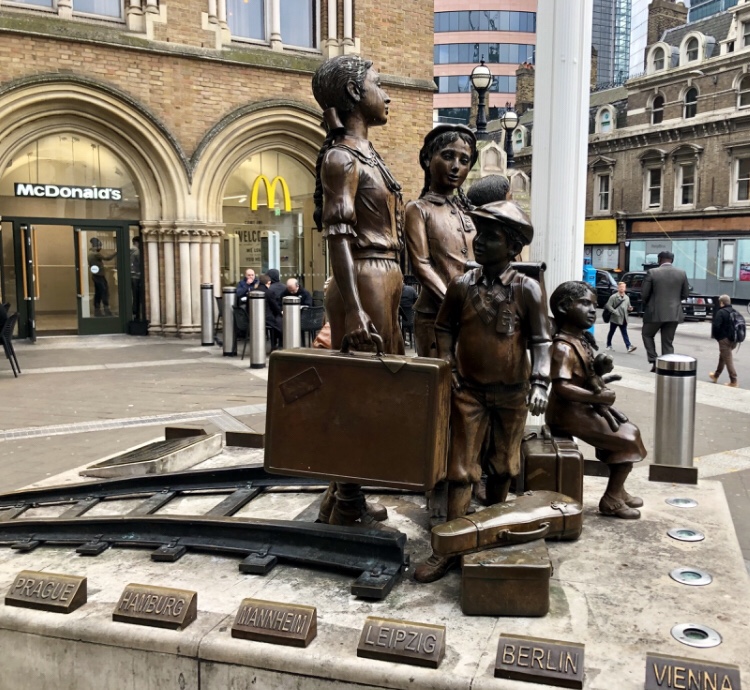
Lisa Bechner, a second generation survivor who was awarded an honorary MBE in 2022 for services to UK-Germany relations and the British commemoration of the kindertransport rescue effort, said: “Even as Prince of Wales, the King was very supportive and people from the kindertransport scheme memorial meet every five years at Buckingham Palace or St James’s Palace.
“Now, with this Royal visit, it is the first time the German government are showing appreciation of the sculptures and that is why it is important.”
Between November 1938 and August 1939, thousands of children were bundled onto trains and travelled unaccompanied by their parents to countries whose language and culture they did not know. Few saw their families again.
The UK continued to accept children and young people until 1943, taking in 10,000 in total.
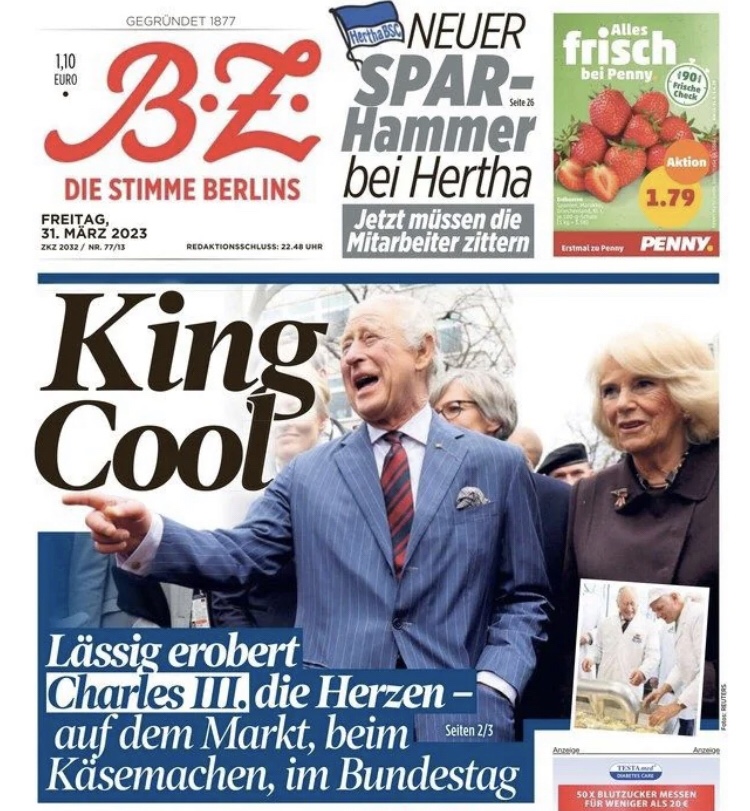
Focus Magazine even asked if it was time Germany had a good-tempered King of their own following the disastrous reign of Kaiser Wilhelm, the country’s last King who was seen as indecisive and ineffective during the First World War.
Correspondent Ulrich Reitz asked, “after this humorous, warm-hearted and simply winning performance by Charles, many may be wondering whether such a king would not do us Germans good”.
The differences between Charles and Wilhelm were “not only in character”, he said.
“Charles is trying to bring about peace in his country. Wilhelm cultivated strife at home and elsewhere, and German megalomania, a legacy Germans still gnaw on.”
 EXTRA TIME
Recent Comments