Eight Goals Conceded…

In twelve games West Ham have not won against the “Seagulls”, and for Rapid it is now even 17 matches without a win against the “Bulls” from Salzburg. But to concede eight goals on a single weekend is really some kind of disaster. And to concede three goals within just 7 minutes in the “Rapid-Viertelstunde” as Rapid did against Salzburg is a pill hard to swallow…
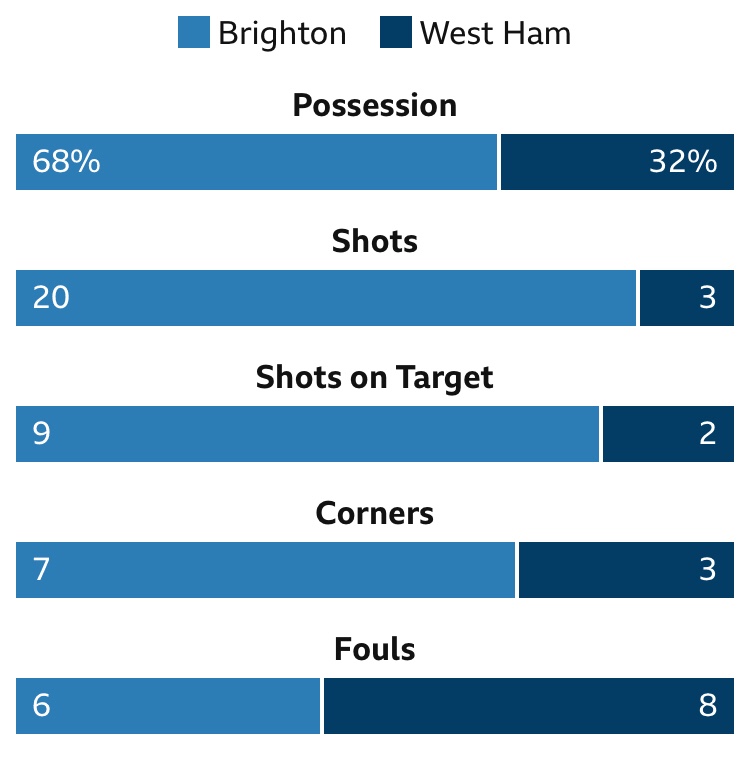
Rapid played quite well however, and even could have been 2-1 up after 78 minutes with good chances spurned, but eventually lost 2-4! West Ham though never stood a chance against Brighton as the statistics show (below), and now the Hammers are again in serious troubles at the wrong end of the table.
Abschied von der großen Freiheit
Zum Tod von Wayne Shorter. Ein Rückblick auf die Sprengkraft des Jazz 🎷

Von GEORG LEYRER (Kurier)
Manche Nachrichten hallen nach. Am Donnerstag ist Wayne Shorter verstorben (der KURIER und der Merkur berichteten), und in die Meldungen vom Tod des legendären Jazz-Saxofonisten mischte sich bald der Nachhall einer Verlusterzählung anderer Art: Shorters Tod erinnert, vielleicht eines der letzten Male, an eine der größten Kulturleistungen des Menschen, an eine Ära, die von vielem sprach, das nun zunehmend unter Druck gerät: an die große Zeit des Jazz und all das, was damit gemeint war.
Längst ist der Jazz in der öffentlichen Meinungslandschaft grau angestrichen und in die Ablage gelegt worden – hört ja niemand mehr, war wohl mal wichtig, aber lange her. In Österreich hängt dem Ganzen auch noch der unscharfe Nachkriegsbegriff dessen nach, was damals als Jazz galt, und zwar alles außerhalb des Schlagers (und manchmal sogar der).
Welch fahles Echo ist diese eingegraute Erinnerung aber davon, was diese Musikform im 20. Jahrhundert gewesen ist – nämlich die in vielerlei Art wichtigste Form der Hochkultur, eine der größten künstlerischen Leistungen der Menschheit überhaupt. Und eine Behauptung, nein: ein Beharren auf Freiheit in einer Zeit, als diese Freiheit noch allerorten erkämpft werden musste. Und nicht, wie heute mancherorts, aus dem Luxus des Vorhandenen freihändig weggeworfen wurde.
Diese Musik ist, man kennt die Geschichte, gegen schwierigste Bedingungen entstanden. Selbst Superstar Miles Davis, mit dem Wayne Shorter prägende Aufnahmen und Konzerte spielte, hatte bei Auftritten mit der damaligen Rassentrennung in den USA zu kämpfen; die Stimmung war aufgeheizt. Europa hatte es sich nach dem Zweiten Weltkrieg weitgehend in der Konformität des Wirtschaftswunders bequem gemacht.
SpitzenleistungenIn diesem Umfeld war eine Musik, die von einer diskriminierten Minderheit ausgehend die Mehrheitskultur nicht nur ästhetisch, sondern vor allem auch intellektuell überholte und weit hinter sich ließ, ein gesellschaftspolitisches Erdbeben.
Jahrzehnte später sollte der Hip-Hop eine parallele Geschichte erzählen: Er wurde zur erfolgreichsten Populärkultur überhaupt.
Das war dem Jazz nicht beschieden. Dass diese Musik aber eben statt auf Breite auf Komplexität setzte und dahingehend bisher unerhörte Spitzenleistungen lieferte, war sogar das gewichtigere Statement: Menschen, die damals als minderwertig angesehen und gesellschaftlich ausgegrenzt wurden, stellten sich hin, legten los – und setzten dem staunenden Publikum einen Wirbel von Improvisation und Freiheit und Könnerschaft vor, der zuvor unerhört gewesen war.
Dieser Wirbel übertrug sich rasch nach Europa – und diente einer Jugend noch vor dem Rock ’n’ Roll und der Flower Power zum Anlass, sich vom Schweigen der Eltern zu emanzipieren.
HinausbegleitetWayne Shorter prägte diese Kunstform, er ist einer der ganz Großen gewesen. Er hat den Jazz auch aus dieser Revolution mit hinaus begleitet, als dieser dann ins Hintertreffen geriet. Spätestens in den 1970ern wurde er von Rock, Pop, Disco und dann der elektronischen Musik aus dem Rennen um die Gunst der jungen Menschen geworfen.
Bis heute sind im Jazz Perlen an Musikschaffen zu heben. Diese stehen in einer grandiosen Tradition, die jeder Erinnerung würdig ist: Wer die Revolutionen von gestern vergisst, riskiert nämlich die Errungenschaften von heute.
„Hanse der Woche“: die EFL
Diese Woche geht die Auszeichnung „Hanse der Woche“ (benannt nach Hans Krankl) nicht an eine Person, sondern an die English Football League, kurz EFL.
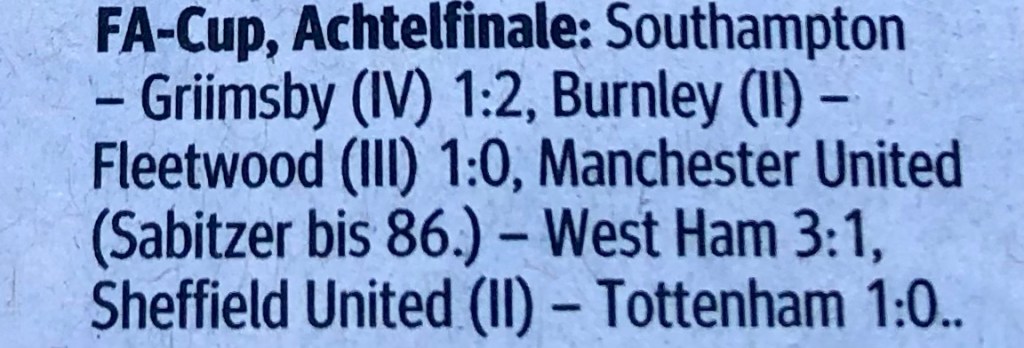
Die zweite bis vierte Division der englischen Fußballpyramide hat sich diese Ehrung durch den RapidHammer dadurch verdient, dass heuer die Hälfte der Klubs im FA Cup-Viertelfinale ligamäßig nicht in der Premier League spielt, sondern in der Championship, in der League One und sogar in der League Two (der vierten Leistungsklasse in der Fußball-Pyramide)! Dabei wurden von den Football League Teams zuletzt unter anderem Tottenham und Southampton ausgeschaltet.
Und das ist die Auslosung für das Viertelfinale des ältesten Cupbewerbs der Welt:

West Ham United – das heuer leider im Viertelfinale mit 1:3 gegen Manchester Utd ausgeschieden ist – war 1980 das letzte Team, das nicht in der obersten Liga spielte und den FA Cup gewann (1:0 gegen Arsenal, Torschütze Trevor Brooking).

Seit es die Premier League gibt (1992), war noch nie ein Unterlassungen Team englischer Cupsieger; 2008 kam Cardiff City ins Finale, verlor aber 0:1 gegen Portsmouth, und 2004 gelang dies Millwall, das 0:3 gegen Manchester Utd verlor.
West Ham 4 Forest 0
A frantic finale with four goals within fifteen minutes gave West Ham a thoroughly needed boost in its fight for Premier League survival: the Hammers deservedly beat Nottingham Forest 4-0 and moved up the table out of the relegation zone.
30 years and one day to the day the great and unforgettable Bobby Moore had died, the Hammers capped a much improved display with a significant win at London Stadium.
Before the game David Moyes, the West Ham manager, was asked about his team’s goal draught as they had only scored 19 goals from 23 games: “I’m not enjoying watching us not score,” Moyes answered, but insisted he had “to find a way to say if we’re not going to score, then how are we not going to lose?”
After a run of games against top-four-chasing Newcastle, and London rivals Chelsea and Spurs, Hammers fans were hoping that the meeting with Nottingham Forest provided an opportunity for Moyes to let his players off the leash, with January signing Danny Ings pushing for a first start. And it was Ings who brought the suffering Irons supporters joy:
Danny Ings scored his first and second goal after his signing from Aston Villa in the January window, making under-pressure manager Moyes run on to the pitch celebrating. Declan Rice and Michail Antonio added two more goals to the former Liverpool and Burnley striker‘s brace.
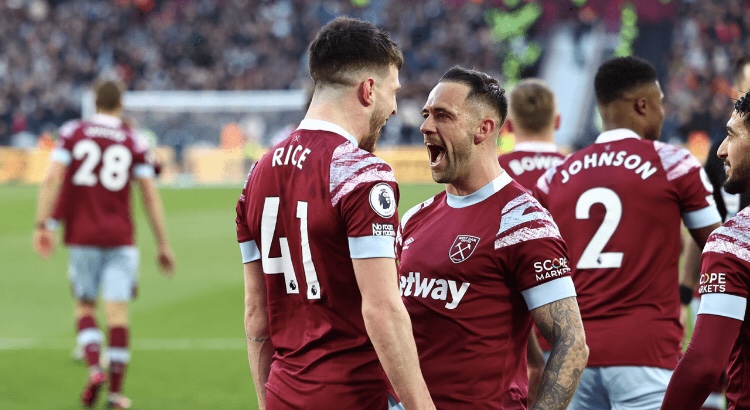
It had been a dire run of one win in 11 Premier League games which came to an end with this victory and a celebration round of the Hammers players after the game. The doubt over West Ham manager David Moyes’s immediate future has gone now as his side responded with an energetic display that eventually swept a limited Forest showing aside. Following the loss at Spurs in the last game, Moyes had suggested he would find out which of his players were “up for the fight”, and it seems he has done well with that.
As he had suggested, in his press conference prior to the game, his players showed quality, “that we’re ambitious, that we want to go and compete and win the game.”
With one league victory since October, Moyes introduced Ings into the starting lineup and also tinkered with his formation, switching to a back four, deploying Tomas Soucek in a more offensive role and handing increased midfield responsibility to Lucas Paqueta.
For 70 minutes however it hadn’t looked like it was going to be Ings’s day any more than his team’s. Coufal and Lukasz Fabianski were forced off with injury and the Hammers had hit the post twice. But the team did not give up trying and in the 70th minute redemption came and it came again three minutes later with Ings’s two goals, whom his manager praised “as someone who knows the art of attacking”. The two goal lead from Ings’s “proper centre forward goals” was doubled when Declan Rice imperiously gambolled forwards, played a cute one-two with Benrahma and curled his first league goal at the London Stadium since May 2021, and when substitute Antonio headed in a cross from short distance.

With this rout that few saw coming (West Ham’s highest win since last May against Norwich) Moyes became only the third manager after Sir Alex Ferguson and Arsene Wenger to achieve 250 Premier League victories. “I’m not coming here with champagne and saying everything’s hunky dory,” Moyes insisted after the game. “But I’m thrilled. I’m going to have wine tonight. Why should I not? We’ve had bad days recently. I know there’s been a lot of noise outside the club, but there’s been nothing inside: I’ve had incredible backing. To stay in a job, a manager needs good owners. I had it at Preston and Everton and it’s the same here.”
However, some perspective is needed in east London as Nottingham Forest has the worst away record in the league, and the win means “that’sMoyes safe until out of the FA cup, lose to Brighton and exit the ECL”, as some West Ham fan of long experience put it in a comment in The Sunday Times.
Let’s hope that Moyes’s feeling that his team now “felt more like our old selves”, will last into the next games and help them climbing up the table and “look at the teams above”. The next league games are Brighton away and Aston Villa at home, but also the FA Cup and European journeys continue with a game every three or four days: next Wednesday it’s Manchester Utd away, and then AEK Larnaca is waiting in West Ham’s first tie of the knock-out round of the UEFA Conference League.
Come on you Irons!
For us, there is only the trying. The rest is not our business

“East Coker,” from *The Four Quartets*
I.

In my beginning is my end. In succession
Houses rise and fall, crumble, are extended,
Are removed, destroyed, restored, or in their place
Is an open field, or a factory, or a by-pass.
Old stone to new building, old timber to new fires,
Old fires to ashes, and ashes to the earth
Which is already flesh, fur, and faeces,
Bone of man and beast, cornstalk and leaf.
Houses live and die: there is a time for building
And a time for living and for generation
And a time for the wind to break the loosened pane
And to shake the wainscot where the field mouse trots
And to shake the tattered arras woven with a silent motto.

  In my beginning is my end.  Now the light falls
Across the open field, leaving the deep lane
Shuttered with branches, dark in the afternoon,
Where you lean against a bank while a van passes,
And the deep lane insists on the direction
Into the village, in the electric heat
Hypnotized. In a warm haze the sultry light
Is absorbed, not reflected, by grey stone.
The dahlias sleep in the empty silence.
Wait for the early owl.
                       In that open field
If you do not come too close, if you do not come too close,
On a summer midnight, you can hear the music
Of the weak pipe and the little drum
And see them dancing around the bonfire
The association of man and woman
In daunsinge, signifying matrimonie—
A dignified and commodiois sacrament.
Two and two, necessarye coniunction,
Holding eche other by the hand or the arm
Whiche betokeneth concorde. Round and round the fire
Leaping through the flames, or joined in circles,
Rustically solemn or in rustic laughter
Lifting heavy feet in clumsy shoes,
Earth feet, loam feet, lifted in country mirth
Mirth of those long since under earth
Nourishing the corn. Keeping time,
Keeping the rhythm in their dancing
As in their living in the living seasons
The time of the seasons and the constellations
The time of milking and the time of harvest
The time of the coupling of man and woman
And that of beasts.  Feet rising and falling.
Eating and drinking.  Dung and death.
  Dawn points, and another day
Prepares for heat and silence. Out at sea the dawn wind
Wrinkles and slides. I am here
Or there, or elsewhere. In my beginning.


II.

What is the late November doing
With the disturbance of the spring
And creatures of the summer heat,
And snowdrops writhing under feet
And hollyhocks that aim too high
Red into grey and tumble down
Late roses filled with early snow?
Thunder rolled by the rolling stars
Simulates triumphal cars
Deployed in constellated wars
Scorpion fights against the sun
Until the Sun and Moon go down
Comets weep and Leonids fly
Hunt the heavens and the plains
Whirled in a vortex that shall bring
The world to that destructive fire
Which burns before the ice-cap reigns

  That was a way of putting it—not very satisfactory
A periphrastic study in a worn-out poetical fashion,
Leaving one still with the intolerable wrestle
With words and meanings. The poetry does not matter
It was not (to start again) what one had expected.
What was to be the value of the long looked forward to,
Long hope for calm, the autumnal serenity
And the wisdom of age? Had they deceived us
Or deceived themselves, the quiet-voiced elders,
bequeathing us merely a receipt for deceit?
The serenity only a deliberate hebitude,
The wisdom only the knowledge of dead secrets
Useless in the darkness into which they peered
Or from which they turned their eyes. There is, it seems to us,
At best, only a limited value
In the knowledge derived from experience.
The knowledge imposes a pattern, and falsifies,
For the pattern is new in every moment
And every moment is a new and shocking
Valuation of all we have been. We are only undeceived
Of that which, deceiving, could no longer harm.
In the middle, not only in the middle of the way
But all the way, in a dark wood, in a bramble,
On the edge of a grimpen, where is no secure foothold,
And menaced by monsters, fancy lights,
Risking enchantment. Do not let me hear
Of the wisdom of old men, but rather of their folly,
Their fear of fear and frenzy, their fear of possession,
Of belonging to another, or to others, or to God.
The only wisdom we can hope to acquire
Is the wisdom of humility: humility is endless.

  The houses are all gone under the sea.

  The dancers are all gone under the hill.


III.

O dark dark dark. They all go into the dark,
The vacant interstellar spaces, the vacant into the vacant,
The captains, merchant bankers, eminent men of letters,
The generous patrons of art, the statesmen and the rulers,
Distinguished civil servants, chairmen of many committees,
Industrial lords and petty contractors, all go into the dark,
And dark the Sun and Moon, and the Almanach de Gotha
And the Stock Exchange Gazette, the Directory of Directors,
And cold the sense and lost the motive of action.
And we all go with them, into the silent funeral,
Nobody's funeral, for there is no one to bury.
I said to my soul, be still, and let the dark come upon you
Which shall be the darkness of God. As, in a theatre,
The lights are extinguished, for the scene to be changed
With a hollow rumble of wings, with a movement of darkness on darkness,
And we know that the hills and the trees, the distant panorama
And the bold imposing facade are all being rolled away—
Or as, when an underground train, in the tube, stops too long between stations
And the conversation rises and slowly fades into silence
And you see behind every face the mental emptiness deepen
Leaving only the growing terror of nothing to think about;
Or when, under ether, the mind is conscious but conscious of nothing—
I said to my soul, be still, and wait without hope
For hope would be hope for the wrong thing; wait without love
For love would be love of the wrong thing; there is yet faith
But the faith and the love and the hope are all in the waiting.
Wait without thought, for you are not ready for thought:
So the darkness shall be the light, and the stillness the dancing.
Whisper of running streams, and winter lightning.
The wild thyme unseen and the wild strawberry,
The laughter in the garden, echoed ecstasy
Not lost, but requiring, pointing to the agony
Of death and birth.

                         You say I am repeating
Something I have said before. I shall say it again,
Shall I say it again? In order to arrive there,
To arrive where you are, to get from where you are not,
  You must go by a way wherein there is no ecstasy.
In order to arrive at what you do not know
  You must go by a way which is the way of ignorance.
In order to possess what you do not possess
  You must go by the way of dispossession.
In order to arrive at what you are not
  You must go through the way in which you are not.
And what you do not know is the only thing you know
And what you own is what you do not own
And where you are is where you are not.


IV.

The wounded surgeon plies the steel
That questions the distempered part;
Beneath the bleeding hands we feel
The sharp compassion of the healer's art
Resolving the enigma of the fever chart.

  Our only health is the disease
If we obey the dying nurse
Whose constant care is not to please
But to remind of our, and Adam's curse,
And that, to be restored, our sickness must grow worse.

  The whole earth is our hospital
Endowed by the ruined millionaire,
Wherein, if we do well, we shall
Die of the absolute paternal care
That will not leave us, but prevents us everywhere.

  The chill ascends from feet to knees,
The fever sings in mental wires.
If to be warmed, then I must freeze
And quake in frigid purgatorial fires
Of which the flame is roses, and the smoke is briars.

  The dripping blood our only drink,
The bloody flesh our only food:
In spite of which we like to think
That we are sound, substantial flesh and blood—
Again, in spite of that, we call this Friday good.


V.

So here I am, in the middle way, having had twenty years—
Twenty years largely wasted, the years of l'entre deux guerres
Trying to learn to use words, and every attempt
Is a wholly new start, and a different kind of failure
Because one has only learnt to get the better of words
For the thing one no longer has to say, or the way in which
One is no longer disposed to say it. And so each venture
Is a new beginning, a raid on the inarticulate
With shabby equipment always deteriorating
In the general mess of imprecision of feeling,
Undisciplined squads of emotion. And what there is to conquer
By strength and submission, has already been discovered
Once or twice, or several times, by men whom one cannot hope
To emulate—but there is no competition—
There is only the fight to recover what has been lost
And found and lost again and again: and now, under conditions
That seem unpropitious. But perhaps neither gain nor loss.
For us, there is only the trying. The rest is not our business.

  Home is where one starts from. As we grow older
The world becomes stranger, the pattern more complicated
Of dead and living. Not the intense moment
Isolated, with no before and after,
But a lifetime burning in every moment
And not the lifetime of one man only
But of old stones that cannot be deciphered.
There is a time for the evening under starlight,
A time for the evening under lamplight
(The evening with the photograph album).
Love is most nearly itself
When here and now cease to matter.

Old men ought to be explorers
Here and there does not matter
We must be still and still moving
Into another intensity
For a further union, a deeper communion
Through the dark cold and empty desolation,
The wave cry, the wind cry, the vast waters
Of the petrel and the porpoise. In my end is my beginning.
© 1943, 1971. Thomas Stearns Eliot, *The Four Quartets*. San Diego: Harcourt Brace & Company, 1988


SK Rapid‘s European Journey 1995/96
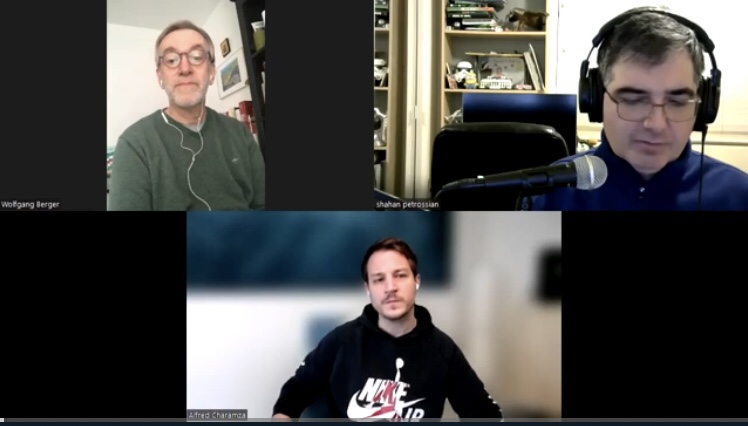
Simon-Peter Charamza und Wolfgang Berger together with Soccernostalgia blogger Shahan Petrossian looked back on SK Rapid’s successful European campaign of 2005/06 in which Rapid Wien reached the Cup Winners’ Cup Final for the second time after 1985!

Stephan Marasek, Zoran Barisic, Didi Kühbauer and Peter Stöger (Onze-Mondial, May 1996)
Video Interview-Part 50 / Podcast Part 65 – A video Interview and blog presentation with Austrian Blogger Mr. Wolfgang Berger and Mr. Simon-Peter Charamza, Head of Development and Digital Projects at ÖFB (Austrian Football Association), discussing SK Rapid Wien’s journey during the 1995/96 Cup Winners Cup.
All the facts about this memorable European campaign of Rapid Wien can be read here ➡️ Soccernostalgia (Blog).
This video about the European journey to the final in Brussels is worth watching and brings back many beautiful memories ➡️ YouTube.

Rapid Wien lineup in the final, 8 Mai 1996: Konsel; Hatz-Ivanov-Schöttel-Guggi; Heraf-Stöger-Kühbauer-Marasek; Jancker-Stumpf (Barisic)
For me it’s indubitable that this Rapid team was one of the best of the last 40 years. Or maybe the best of this period?
Well, in my opinion the team which reached the European Cup Winners’ Cup final in 1985 (with Hans Krankl and Antonin Panenka) or the team which won the latest Austrian championship in 2008 under manager Peter Pacult also stand out. Or should an other team be mentioned, too? Which one really was the best?
Food for thought and discussion…
Too good to go down?
The question is written on the wall. And the writing gets more and more terrifying for West Ham United, the longer the Hammers are not winning enough to climb up the table.
West Ham had not lost for one month, but had only picked up one win and two draws from their three Premier League matches since their defeat against Wolves in mid-January. And with their 0-2 against Tottenham on Sunday they are third from bottom now.

“Under Avram Grant we were on 20 points from 23 games,” Denis of the Austrian supporters club hinted at the coincidences with the season of 2010/11. “We got relegated [with Grant as manager], this season exactly the same.”
And Clemens of Austrian Irons said: Moyes “definitely has to go after yesterday. Spurs were not great but we were abysmal. Just sat back, non existent at the front. Moyes has no idea or game plan. Sets up the same everytime. All the opponents have worked it out already. Too easy for them.”
The statistics show how everything which was good the last two seasons at West Ham has changed:

In an interview following the 2-0 defeat at Tottenham, captain Declan Rice hinted that all is not well in the West Ham camp. The 23-year-old delivered a thinly-veiled critique of manager David Moyes’ game plan when speaking to Sky Sports after the game suggesting that Moyes’ safety-first tactical approach was hindering the team’s ability to score goals – an issue that has been present all season.
With regards to the manner in which West Ham approached the game, he added: “When you play with five at the back and the three, like we set up today, maybe our strikers felt a bit isolated when we got the ball up to them — they didn’t really have enough around them, not enough support.”
Looking ahead to next weekend’s relegation clash with Nottingham Forest, Rice admitted the team need to step up – but insisted that surviving the dreaded drop was still in the team’s own hands.
David Moyes said: “Look, we all, with me at the front of it, have got to put our chests out and get on with it.”
With the success of the last two seasons in mind, it’s hard to believe that this team could go down. It’s better than the squad which Avram Grant had on his hand 2010/11 when West Ham was relegated for the last time so far, but in 2002/03 when the Hammers were relegated previously, no one really thought that a team with Di Canio, Michael Carrick, Joe Cole, Jermain Defoe, Trevor Sinclair and other very good players would go down.
This season has some coincidences to then, let’s hope they won’t go so far. But the question is if David Moyes still is the man to motivate the Hammers squad to pull up their sleeves and avoid the drop this term!
 EXTRA TIME
Recent Comments